
The Shadow Wolf: Wolves, Folklore and Britain's Lost Wild
On Mac Tire, the British wolf's erasure, and why the absence still has a shape

"Wolves have been absent from Britain for over three hundred years. But they left a shape in things."
I was maybe seven years old the first time a wolf properly scared me.
It wasn’t a real wolf. It was that terrifying wolf creature called (and I had to do some Google searches to remember the name, which led me down a nostalgic garden path) ’Gmork’, the creature sent to hunt Atreyu in The Neverending Story. The eyes, the black fur, the teeth and the animatronic movement of the mouth, which makes it look rather unnatural, all combined with the shadows in the scene to play havoc with my young mind.
I’ve been fascinated by wolves ever since. Of course, this representation of the wolf is fantasy, a villain, which is a curse for the wolf. My curiosity took me to dream and imagine these fearsome creatures with awe. I love them, their mystery, their beauty, their ferociousness. I read the Call of the Wild, which was a different take on wolves, a less fantastical one, but one which was just as terrifying in its sadness and melancholy.
Fear and fascination. That’s always been the relationship.
We destroyed wolf populations in Britain and the world. Wolves roamed Britain for thousands of years. They crossed from Europe at the end of the last Ice Age, following the herds, and remained in the land. They were woven into everything, place names, law, the old stories. In 957, King Edgar of England demanded three hundred wolf pelts from Wales as tribute. Not a rarity. Not a curiosity. A fact of the land.
Servants to kings could earn land grants on the condition they rid it of wolves. Organised hunts. Bounties. Forests burned. By the reign of Henry VII, around 1485, they were gone from England. Scotland held out longer. The last wolf is said to have been killed at Killiecrankie in 1680, though some accounts stretch that to 1743. Nobody’s entirely sure.
We didn’t just hunt them. We decided they didn’t belong here.
Before modern man rewrote the story, the Celts saw wolves very differently. In Gaelic, the wolf is Mac Tire: Earth’s Son. The Fianna, the great Irish warrior band, were wolf-warriors. They wore wolfskins. They lived at the edge of the human world, in the wild places, which is exactly where wolves lived too. The wolf wasn’t a monster. It was other. It belonged to the margin, the place beyond the field’s edge where the old rules didn’t quite apply.
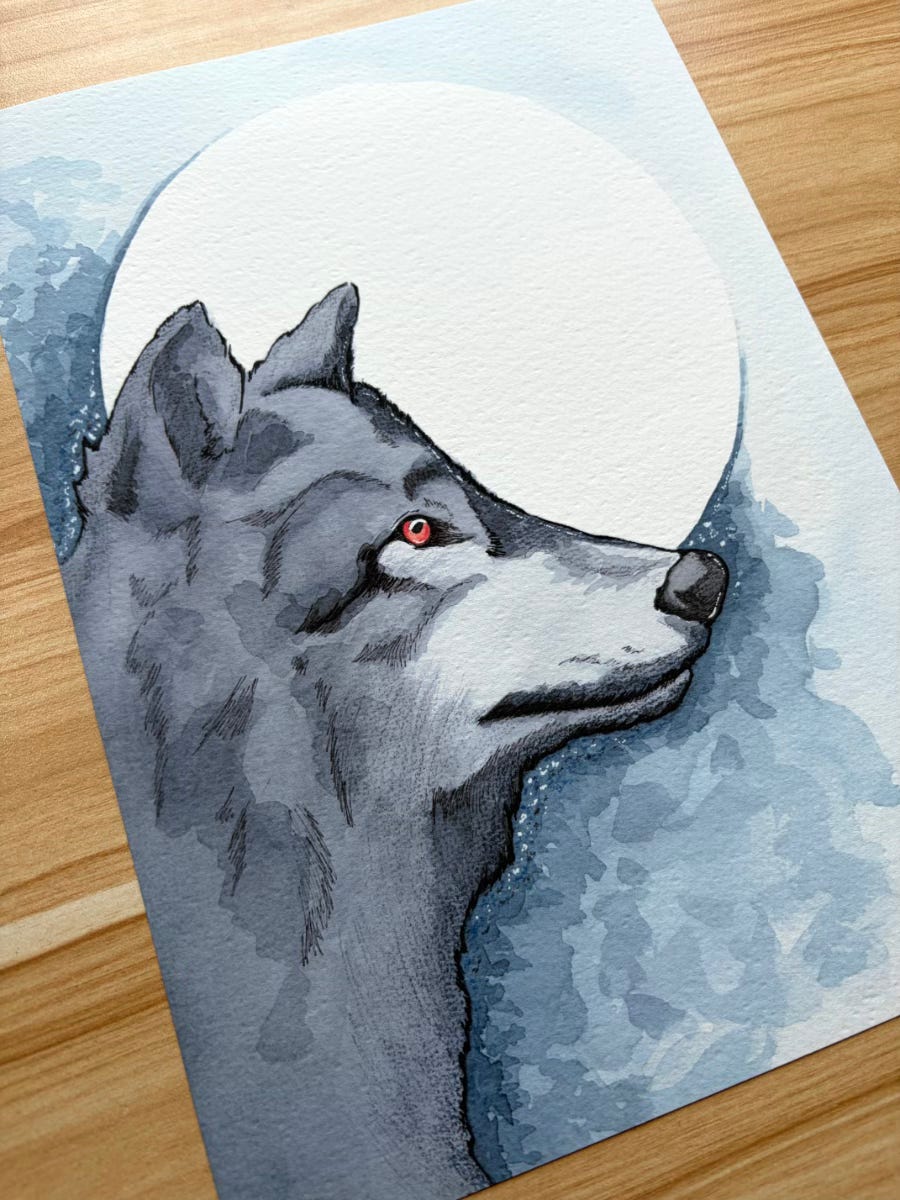
That’s the wolf I painted. Not a threat. Something watchful and self-contained, lit by a cold moon, facing away. Already leaving. The red eye is the last thing, a backward glance from something that was here long before us and knows it.
The wolf is absent from Britain. But it left a shape in things. You feel it in certain landscapes, high moors, the old pine forests of Scotland, the places that still seem to be waiting for something to return. A presence defined by its absence.
Gmork scared me because he wasn’t evil in a simple way. He served the Nothing, the erasure of story, of wildness, of everything that can’t be tamed. That’s what we did to the British wolf. We served the Nothing.
The question now is whether we have the nerve to bring the story back. Can rewilding efforts work and actually produce change or have we lost hope, as Gmork says after Atreyu asks ‘Why is Fantasia dying then?’ Gmork responds with: ‘Because people have begun to lose their hopes and forget their dreams. So, the Nothing grows stronger.’
Learn more about my Shadow Collection here - CLICK HERE
Sources: Wolves in Great Britain, Wikipedia. Wolves and Humans Foundation, wolvesandhumans.org. The Druid’s Cauldron, Wolves in Irish Myth.
Thanks for reading. If you enjoyed this you can find more at The Wild Margin, or come and see the paintings at stephenholder.art. I’m also on Instagram and Facebook if you’d like to follow along there.